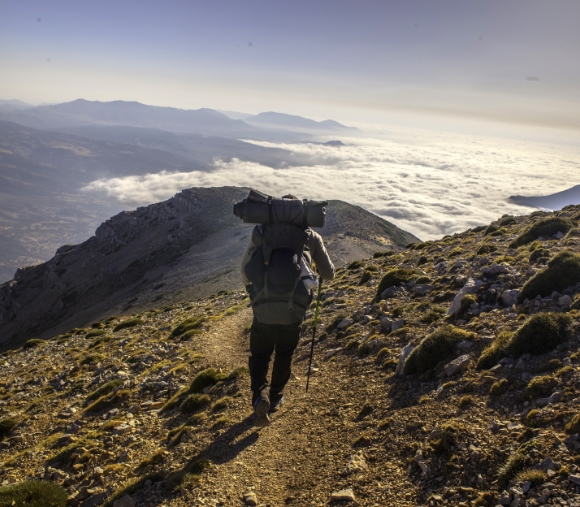
THE PROTAGONIST OF OUR STORY is a "pilgrim", albeit in the etymological sense of the word, because he is willing to cross the fields of this territory with different motivations and perspectives that are compatible with each other, whether sporting, cultural in a broad sense, and/or religious-spiritual.
THE MESSAGE is to promote the territory and surroundings of the pilgrimage route with its associated history, that is to say, a geography and landscape steeped in history, with spiritual significance, both for its natural heritage and its cultural heritage in the broadest sense, and whose appeal must be conveyed to the mere passer-by so that they return as a pilgrim or visitor.
Our pilgrim stands at the top of the city of Guadix, at the Padre Poveda viewpoint, next to the Cuevas neighbourhood, where he carried out exemplary educational work. He is there as a starting point. Tradition tells us that seven apostolic men, ordained by Saint Peter and Saint Paul, began the Christianisation of Spain in this town, making the cathedral of Guadix the oldest of the Spanish churches, and thus a very appropriate place to begin a journey.
See the Cathedral, the soul and life of Guadix, according to the writer Pedro Antonio de Alarcón, who was born in Guadix, which was built on the remains of the Aljama mosque; and also see the ancient fortress, which will remind you that the path you are about to take leads you through a borderland, specifically that between the Christian kingdoms and the Nasrid kingdom of Granada, traces of which can be seen in the numerous fortresses, watchtowers and lookout posts that you will see along the way. In this special Islamic past, Guadix was the birthplace of many thinkers, including Abentofail, author of the first philosophical novel in human history: "The Self-Taught Philosopher".
The pilgrim can already guess by looking at the horizon that on their journey they will face the inclement weather, but also the landscapes, of the Geopark; a spectacular territory that is home to one of the best continental geological records of the last 5 million years and the most complete set of fossil remains of the large extinct mammals that lived during the Quaternary Period (the last 2.5 million years of Earth's history, when humanity appeared on the planet).
You will descend to visit the Cathedral and discover its treasures.
He will continue on towards Benalúa and from there to Face Retama, a few leagues from Guadix, where he will rediscover the figure of Saint Torcuato, whom tradition also considers to be a disciple of Saint James, patron saint of Spain. And from there, he will be seen crossing and seduced by the desert, where he will acquire a special wisdom: that of simplicity, because he must cross it carrying only the bare essentials; that of solidarity, due to his own awareness of the scarcity of what he carries, which awakens in him the sacred duty of hospitality and, along with it, the power of silence and, therefore, of listening. And serenity, through the humble acceptance of the experience of encountering oneself in a place where one detaches oneself from the accessory and remains with the essential. A journey where one recovers the scent of time because everything passes at a different pace. The desert will no longer be just a type of landscape, but an inner dimension of our human condition.
Between Fonelas and Mount Jabalcón in the distance, the Gorafe desert is a spectacular amalgam of shapes and colours among gullies and ravines. A megalithic park with more than 200 dolmens shows the ancestral sense of spirituality of the first settlers. There are many other vestiges, as you will see later in Orce, that the first inhabitants of Europe settled in this land a million and a half years ago.
Every desert has its oasis, and you will reach the spa resort of Alicún de las Torres with its mineral-medicinal waters, in a peaceful and unique setting surrounded by megalithic remains. The low light pollution in Gorafe allows for a privileged view of the starry sky. And in Freila, from its castle, you can take a detour to the Negratín reservoir, an inland beach, where views of the Torre del Maruq await you.
You will sometimes retrace your steps, with that certain uneasiness that so many have experienced wandering around all kinds of deserts. You will discover viewpoints with unique panoramic views, a group of humble cave houses, some abandoned and others inhabited, but not as splendid as those in Guadix or others to be discovered in Baza, Benamaurel, Cúllar, Castilléjar, Galera and Huéscar.
And connecting with a greenway, you will arrive at Baza. From a distance, you can imagine what was an essential moment for the reconquest in 1489. There, Muslim courage managed to intimidate the Castilian forces despite the disproportionate number of combatants. The siege of the city, which began after the "Battle of Las Huertas", did not end until the Catholic Queen arrived with decisive momentum. The siege lasted six months and large lombardas and other artillery pieces were used with force. And in that moment, just as Caravaca had witnessed the conversion of the Almohad sayid Abu Zeit centuries earlier after the miracle of the appearance of the Cross, in Baza it was their leader Yahya Al Nayyar who, according to legend, after a prodigious vision of a shining Cross in the air next to the apostle Saint Peter, was drawn to sincere conversion.
Although the war continued until early 1492, the capture of Baza in 1489 was in fact the end of the War of Granada, and this was celebrated with enthusiasm in Rome. On Sunday, 10 January 1490, in the Church of Santiago de los Españoles, the Reverend Father Bernardino de Carvajal, Bishop of Badajoz and royal ambassador, began a speech commemorating the conquest of the city of Baza with words from the first epistle of St. John the Apostle, "The victory that conquers the world is our faith," recounting numerous details.
According to chroniclers, the final phase of the reconquest appears in its essence as a unique epic in which the courage and misfortunes of the enemy were treated with respect, and in which such qualities contributed to enhancing the magnitude of the victory. This is how the surrender of King Zagal to the Catholic Monarchs in Guadix was experienced. Furthermore, as recorded in an ancient document, "Although they fought each other in war, when there were truces and peace, they exchanged gifts and presents from one side to the other.
Walking towards Jabalcón hill, climbing to the summit, you will find the chapel of the Virgen de la Cabeza. Once again, you can see semi-desert areas on either side, but also the waters of the Negratín reservoir and, at the foot of the mountain, Zújar, famous for its mineral-medicinal waters and baths.
In honour of the Virgin of La Cabeza, Zújar, Benamaurel and Cúllar celebrate a festival of "Moors and Christians" based on the story of "The Captivity and Rescue of Our Lady, the Virgin of La Cabeza".
Similarly, the festival of "Cascamorras" has its roots in the dispute between Guadix and Baza over the recovery by the people of Guadix of the image of Our Lady of Mercy, which is kept by the people of Baza.
After passing through Benamaurel, travellers are alerted to the next town, Cúllar, by the Torre del Alabí, a Nasrid tower located on a hill opposite the town, which today serves as the bell tower of an adjoining chapel. Many other bell towers can be heard along the way. Cúllar was an ancient crossroads, where Almanzor stopped with his troops, as did Don Juan de Austria centuries later.
Orce and Galera are quite an archaeological event. If Baza has its famous large Lady, Galera also has one, a figurine seated between two sphinxes, holding a bowl into which she pours liquid through two holes in her breasts, and Cúllar has its anthropomorphic idol from the El Malagón site located on a promontory in the municipality.
Thus, our walker, glimpsing some orchards among narrow strips of land, will reach the Fuencaliente spring, which has been converted into a natural pool, the threshold of Huéscar. If in the distance he could previously see the imposing pyramid of Mount Sagra, 2,383 metres high, now, shortly afterwards, he can see the Sierra de la Encantada on his right, where a fortress preceded the city of Huéscar, and in the background, in the distance, the Sierra de Marmolance.
In the city: the collegiate church of Santa María Mayor de la Encarnación, a jubilee temple granted by Benedict XVI, a cathedral of Toledo in Granada, as it has been called due to its magnificence and its ecclesiastical dependence on Toledo until the 20th century, the church of Santiago and the convents of Santo Domingo and San Francisco. In the surrounding mountains, dotted with numerous watchtowers, Segureña sheep and numerous wild animals graze. As the darkest region on the Iberian Peninsula's light pollution maps, it offers magnificent spots for stargazing. And in one of them, overlooking La Sagra, many claim to have found the true source of the Guadalquivir River.
The conquest of the city in 1435 achieved literary fame thanks to Fernando del Pulgar, who recounted the life of Don Rodrigo Manrique, father of the great poet Jorge Manrique, author of the famous verses on the death of his father, among the lives of "the illustrious men of Spain". Miguel Lafuente Alcántara also recounted it magnificently. Don Rodrigo crossed the Sierra de Segura and conquered the city of Huéscar in a valiant attack, maintaining it with the help of Don Fadrique de Toledo. Years later, it fell back into Muslim hands, but in 1488, during the Catholic Monarchs' campaign towards Baza, it returned to Christian rule.
The pilgrim suddenly enters a new landscape that explains the great biodiversity of the territory, water and forests. They will walk towards Puebla de Don Fadrique along the route to the chapel of the Holy Martyrs Nunilón and Alodía, on the slopes of the sacred mountain, whose relics evoke the devotion of the ancient Navarrese and Aragonese repopulators. Arab chroniclers in the 12th century recount that, in what today seems to coincide with this place, there was a miraculous olive tree that blossomed and, as soon as night fell, olives formed. Christian literature associated this event with the figure of Saint Torcuato, due to his martyrdom next to an olive tree. Documents from the 16th-century Huéscar archive bear witness to the pilgrimages made to see it.
Follow the road to the town formerly known as Volteruela, which, under the influence of the 2nd Duke of Alba, was renamed Puebla de don Fadrique. An interesting fact about this place is that a particular congregation of the Spanish Counter-Reformation, founded in the 17th century, continues to celebrate the "Exercise of Good Death", a strict practice of discernment around one's own death in order to face it properly.
Arriving in Almaciles, three kilometres from the border with the Region of Murcia, where there has been a coaching inn since ancient times, a symbolic bridge, no longer used by vehicles, points towards the Cruz de Caravaca. However, this route connecting the east coast with the interior of Granada was already widely used in the 1st century BC, as evidenced by the Roman fortifications of Archivel and Barranda, which were built during the wars between Caesar and Pompey in that century. There are also records of this route throughout the medieval period. It was travelled by Alfonso I the Battler, King of Aragon, who, encouraged by the Mozarabs of Granada, came to their aid. It is known that, together with him and his 2,000 soldiers, some 8,000 Mozarabs returned along this road and settled in Aragonese lands.
The appearance and presence of the Cross in Caravaca dates back to the time when it was established as a new Christian frontier against Islam, yet countless merchants who traded between Valencia and Granada used this route. However, the Vera Cruz de Caravaca, based on its sacred and mysterious origin, radiated an aura of protection that sheltered the advance troops, the members of the Orders, and the Christian inhabitants of that land, the frontiersmen. Many, freed from captivity, gratefully came to deposit their chains, as votive offerings, in the chapel of the fortress where the Cross was guarded by the military Order in charge of the castle, first the Templars and, after their dissolution, the Order of Santiago.
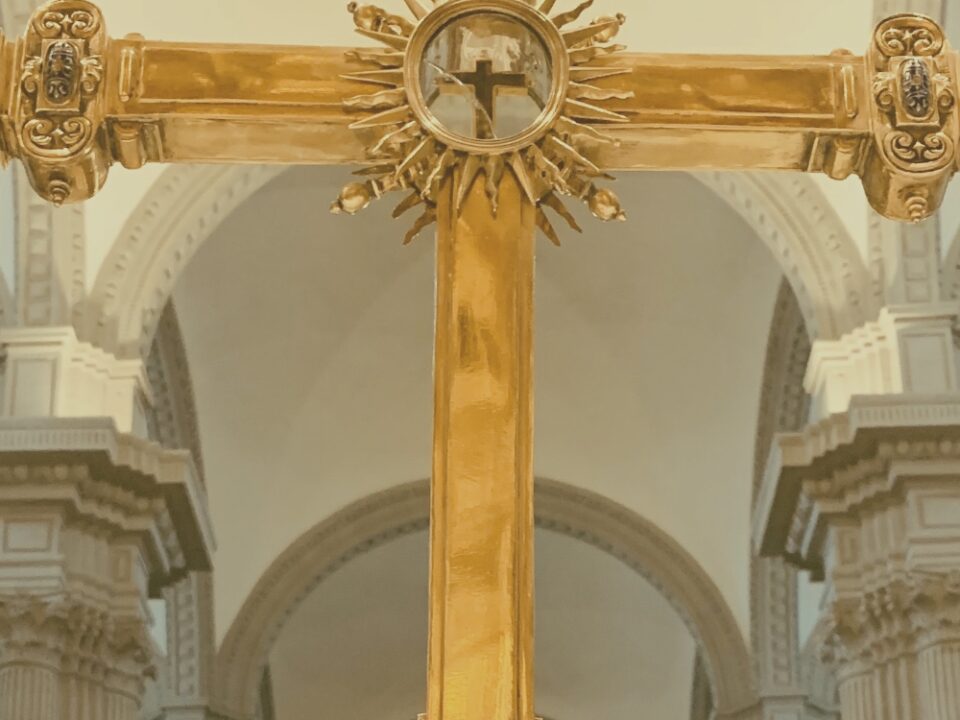
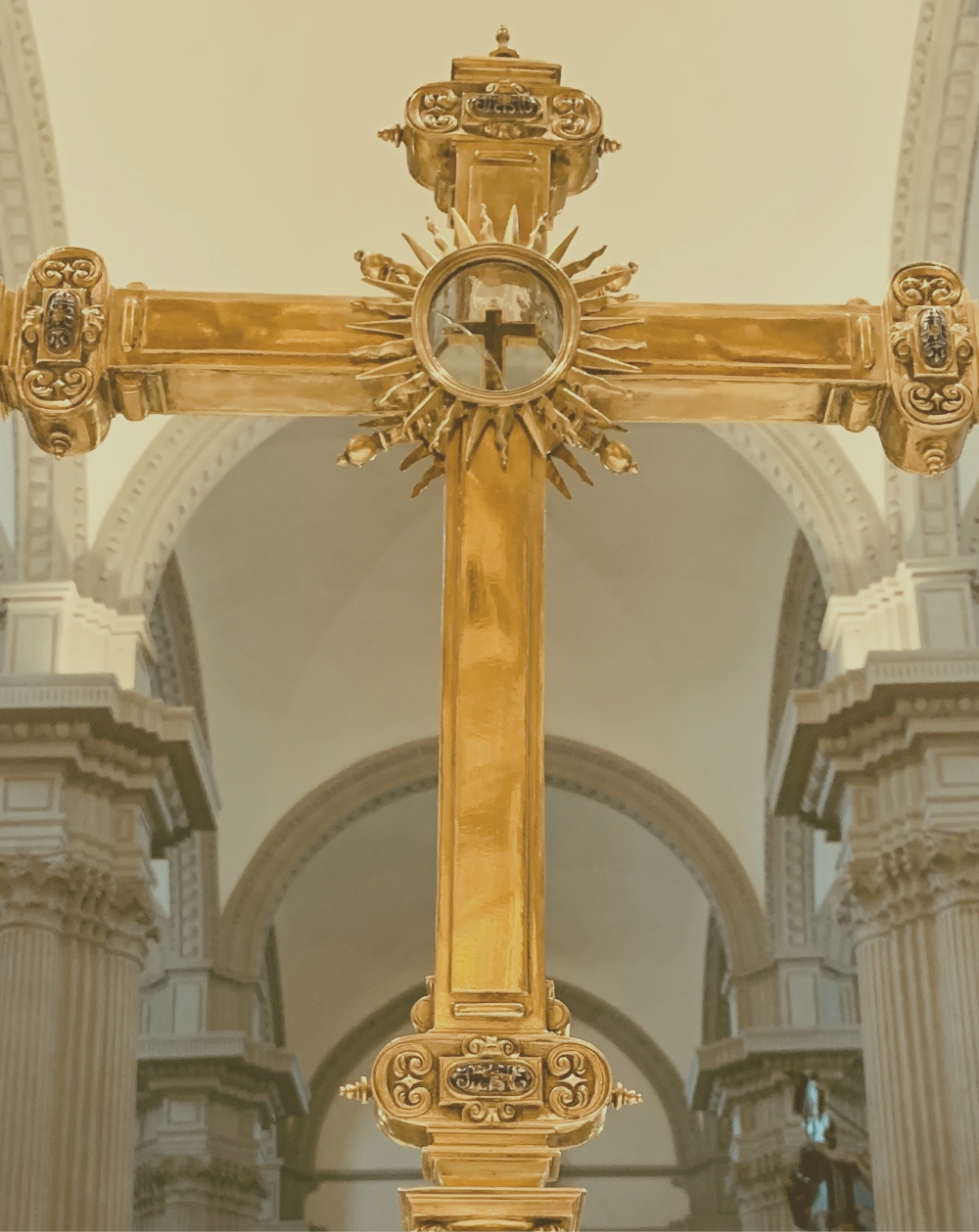
The Cross thus appeared with immense courage, which has been preserved for various reasons to this day, the final destination of our pilgrim, who must do as King Ferdinand the Catholic did after stopping in Huéscar, already under his rule, who, giving his troops a respite until further orders, went to pray before the blessed Cross of Caravaca.